Simon Armitage has a new translation of Sir Gawain and the Green Knight. A poet friend of mine was very happy with the news, and raised my expectations regarding its quality. I'm looking forward to reading it.
Yesterday, Armitage was interviewed on NPR's On Point, and that interview is available here. I have to confess, I only listened to about 15 minutes worth before I could no longer stand Tom Ashbrook and his callers. And using Sword of the Valient unironically? Yeesh!
Via Stán Cynedóm
Wednesday, October 10, 2007


Venison, with just a hint of snake
Medieval bestiaries must be what's hot at the moment, because Heavenfield has an entry about the symbolism of stags that eat snakes.
Tuesday, October 09, 2007
Geekerati, Elvira, and Me
Last night Christian Johnson of Cinerati hosted me on the Geekerati radio program, where we did a once-over-lightly skim over popular medievalism, dwelling the most on Lord of the Rings and our favorite films. You can hear the episode here, or by hitting the play button below (assuming, optimistically, I got the html right).

Though the whole experience was delightful (including my father's insider comments in their chat room), perhaps the best part is that I was featured on BlogTalkRadio's main page, nestled between two lovely women, one of whom was Elvira, Mistress of the Dark ... and few women can nestle a man in quite the way Elvira can. I would post my screen capture of that page, but I can't seem to get it in a form that Blogger will take.
Though the whole experience was delightful (including my father's insider comments in their chat room), perhaps the best part is that I was featured on BlogTalkRadio's main page, nestled between two lovely women, one of whom was Elvira, Mistress of the Dark ... and few women can nestle a man in quite the way Elvira can. I would post my screen capture of that page, but I can't seem to get it in a form that Blogger will take.
Monday, October 08, 2007
Terry Jones on our Maligned Middle Ages
News for Medievalists has an interview with Terry Jones, most famous for his work on Monty Python. What non-medieval scholars might not know is that Terry Jones is a legitimate scholar of medieval history, not just a celebrity popularizer. Nearly every literary scholar I know who has read Jones's Chaucer's Knight says exactly the same thing about it: "Very, very good. Totally wrong, of course, but still quite good." I recommend it as a history book, but I would suggest taking its literary thesis (that the Knight of Chaucer is meant to be read ironically) with a hefty grain of sea salt.
By the way, Amazon lists Chaucer's Knight at $118.34! Um, it's not that good. Get it directly from the publisher for 12.99 pounds (about $26 US).
In either case, the interview is very good also. Give both a read.
By the way, Amazon lists Chaucer's Knight at $118.34! Um, it's not that good. Get it directly from the publisher for 12.99 pounds (about $26 US).
In either case, the interview is very good also. Give both a read.
TWO Weird Medieval Animals!
Jennifer Lynn Jordan at Per Omnia Saecula has not only discharged her Monday bloggerly duties with the latest installment of Weird Medieval Animal Monday, on the amphisbaena, but she gave us a bonus animal the Friday before, with the hedgehog.
An Outsider's View of the SCA
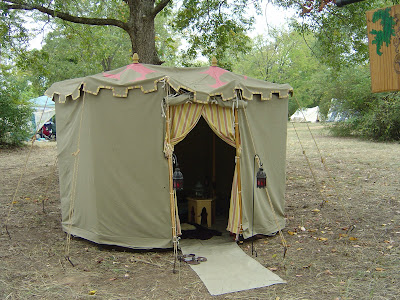
I had originally intended to write a single post about my trip the Pillage on the Plains IV, but now that I've gone, I think a couple of different posts are in order. This first one is in response to the various questions I've gotten from outsiders about exactly what the SCA is. I should note that my own experience is limited to interviewing a few people, attending a couple of business meeting-style functions, and spending the weekend at Pillage on the Plains, so this is definitely an outsider's view. Real SCAdians will no doubt have a different take, and I hope that none of my comments here will unintentionally give offense.

Lady Heather and Lord Richard, my hosts.
First of all, SCA is the Society for Creative Anachronism, an organization of medieval re-enactors that has been around for over 40 years. You can find their office web page here, the Wikipedia entry here, and various bloggers involved in the SCA on my blogroll. It's kind of similar to Civil War reenactors, though it's more of a mash-up of various times and places.

The Honorable Lord Edward of Yarborough, Troy University alumnus.
One other level of similarity with Civil War reenactors is the use of history. I've often heard American historians complain that they're accosted by Civil War buffs who know everything there is to know about the single important unit or battle their great-great-granddaddy was in, but they don't have a broader perspective. Sometimes these folks can become offended when said historian doesn't know much (if anything) about their ancestors' battles. More than once I've heard historians describe this exchange:
Buff: So, you're a Civil War historian, huh?My experience has been that, while SCAdians don't get angry like that when you don't know about their passion -- indeed, they are delighted with the opportunity to tell you all about it. Still, the understanding of history is similar: lack of a broad historical understanding, but a deep, deep well of detail about their areas of passion.
Historian: Yes.
Buff: My great-great-grandpappy was in the Battle of Insignificant Mudhole. What do you think about Captain Obscure's decision to flank Lieutenant Nobody's forces rather than attack from the front?
Historian: Um, I really don't know much about that.
Buff: What?! You don't have an opinion about the Battle of the Insignificant Mudhole?! Don't you know that it was the real turning point in the war, since one of the men wounded in that battle was transferred and became Robert E. Lee's shoeshine boy? After all, if not for the gleam of his shoes, Lee would have slaughtered them at Gettysburg. And you call yourself a "historian!"

Yeoman archery tournament
Probably the single term that carries the most force for SCAdians is period, which I take to mean something like "authentic for whatever period it is intended to represent." More than once, I heard the phrase "That's so period!" used to compliment someone on their garb or craft. Still, period can be a loaded term, with some people scoffing at others as being the "period police," mostly because they are critical when something isn't exactly right for the period. It took me a while to figure this out: If an SCAdian says "period," they might mean what anyone else would mean, but they might also be referring to authenticity as a virtue.

Harpist practicing
SCAdians all have a persona, or a character that they are portraying, but the level of detail given to that persona varies wildly. One of the rules seems that you cannot portray an actual historical personage, but the person you portray needs to be "period," so you can't, for example, portray Aragorn of Lord of the Rings. For some people, the persona is just a name; for example, Queen Lethrenn only has a name for her persona, and she varies the period based upon what kind of clothes she wants to wear. In other cases, the backstory of the persona is very detailed, with specific life events mapped out historically. I think the degree of leeway in terms of period can vary from kingdom to kingdom.
Boys playing chess
The above, with its references to a queen and kingdoms, leads to the issue of organization. The world is divided up into various kingdoms, which tend encompass several states (though it should also be noted that they do not necessarily run along state political borders). My own kingdom is Meridies. Each kingdom is further broken down into smaller club-sized groups, and the nearest one to Troy is the Shire of Thorngill. Within the SCA, people hold various offices with medieval-sounding titles, most of which are rough equivalents of modern offices such as treasurer or club president, though there are some that are unique to the SCA -- for example, Lord Richard na Teanga Mihn (my host) is the Youth Combat Marshall. Every kingdom has a king and queen, titles that are won by combat -- so in most cases, the queen is the wife of the king in real life, though this is not necessarily so, and I'm told that some queens have won office by defeating their opponents at arms, so that their husbands became king through them. These particular offices appear to be mostly ceremonial, and a monarch only reigns for 6 months before being replaced. The boring bureaucratic business of the SCA is run by a board of Corporate Officers.

Queen Lethrenn and ladies
By the way, someone mentioned to me that he figured all the SCAdians would have exalted personas -- much in the same way that every Westerner who believes in past lives always seems to have been royalty, and no one ever a slave. The structural culture of the SCA, though, doesn't really allow for that. After all, you can call yourself "Charles the Frank" in an effort to emulate Charlemagne, but what good is it if someone else is King, and you don't even have a grant of arms? Instead, I found that people tended to have the personas of travellers so that they could blend two or more styles they really liked. For example, Lord Beirhart of Douglas (seen here platting rope) is a heathen Viking living in Scotland, because he didn't want to choose between Viking and Scottish styles.

I heard lots of persona stories like that: missionary, merchant, crusader, shipwrecked, freed slave, married to a foreigner ... all these allow for the easy mixing of periods, and I found SCAdians really took to that. In most cases, I suspect that SCAdians are very tolerant of any period or region deviation as long as you have a semi-plausible figleaf in your backstory.

The Aylekeep

Lord Richard and Killian the Black, after sparring
The crafts side varies even more. Anything that you might consider a medieval craft -- blacksmithing, leatherworking, spinning, weaving, period cooking, dance, song, instruments, etc. -- someone is doing it. And they all take this very seriously too. You can't exactly pop down to the WalMart to pick up a suit of armor, tunic, and spinning wheel, can you? The market being so limited, they have to make the items themselves. Even the kinds of things you can find at Renaissance Faires they tend to make themselves, simply to keep costs down (this could be a VERY expensive hobby if you let it). For example, here is a picture of my kids with King Maximillian:
 ... who made every single item he was wearing, except for his underwear. The bottle he is holding was presented as a gift from the children; it's spiced oil they prepared in the children's pavilian. The king (who must be an excellent fighter as he has won the crown three times through feats of arms) also made every single element of his fighting gear except for his boots -- but unfortunately I didn't get a picture of his very beautiful and very functional armor.

Children at court
 That being said, they aren't arrogant about their arts and crafts. Instead, they really want to teach you what they know. SCA would be a great hobby for someone interested in embroidery, or carpentry, etc.

Lord T'Okin (sp?) of Zanzibar and Ian, a crusader
What about warts? In the interest of candor, I would be remiss if I didn't mention the big problem with SCAdians -- a penchant for talking when they should listen.* I had this conversation about a dozen times:
SCAdian: So this is your first event?
Me: Yes.
SCAdian: How did you hear about us?
Me: I'm a professor of medieval literature, so I share a lot of interests with people involved with the SCA.
SCAdian: A professor of medieval lit?! Oh my gosh! When that gets out, you're going to be overwhelmed with questions from people!
But see, here's the thing ... I was never asked a single question. Instead, people found my expertise as an opportunity to tell me things. To be honest, I didn't mind that at all -- it was nice not to have to be a walking lecturer on medieval England -- but sometimes people would launch into extended lectures that reminded me of the old adage about not teaching your grandmother to suck eggs. Several times I had to nod politely while listening to an oft-well-rehearsed and somewhat inaccurate speech about some element of medieval life. Fortunately, though, I'm not a historian so I only noticed the real howlers.

Ginny (?), another first-timer with beautiful garb from Ren Faires.
*I know, in this case I'm the pot calling the kettle black, but I'm trying to give the fairest view I can.
Sunday, October 07, 2007
Unlocking my Wordhoard on Geekerati
I'll be a guest on Geekerati radio this Monday, October 8th, talking about all things medievalist with host Christian Johnson of Cinerati. Though the shows are archived so you can listen to them at your convenience, you can call in during the live broadcast.
Please call! I know Wordhoarders have gone to a lot of trouble to meet me in the past, and here's an opportunity to ask questions (or tell me what an idiot I am) from the comfort of your own home.
Yes, I'm back from the SCA event ... expect several posts regarding that over the next couple of days.
Please call! I know Wordhoarders have gone to a lot of trouble to meet me in the past, and here's an opportunity to ask questions (or tell me what an idiot I am) from the comfort of your own home.
Yes, I'm back from the SCA event ... expect several posts regarding that over the next couple of days.
Friday, October 05, 2007
... and he was never heard from again.
I'm off this weekend to attend Pillage on the Plains IV, my first real SCA event. I'll take pictures and report back to all the Wordhoarders about what went on when I return. I'm hoping to get lots of useful information for my book, so wish me well!
Walter and Drout on the Beowulf Movie
John Walter has developed the theory that, in the Zemeckis Beowulf, Grendel's Mother is the dragon ... that for some reason, Beowulf doesn't really kill Grendel's Mother, and she comes back nastier. Michael Drout, commenting on that theory, agrees that it would be a reasonable way to tighten up the narrative.
Much of this is speculation gleaned from the bits found in trailers, so let's keep that in mind. That being said, I think Drout has hit upon the most difficult matter for any film adaptation of Beowulf: narrative tightness.
The pacing of the poem isn't like the pacing of a film, or even like the pacing of a novel. Beowulf shows up, stays a few days to kill some monsters, then we jump ahead in time to when he's an old man. This is a problem for a film, because the dragon episode isn't just an extended denouement; it's the climactic ending.
Now, if it were up to me, I'd film it as a trilogy based around each monster, because I think audiences would have a greater tolerance for that leap in time if it were a different trip to the movie theater or a different DVD. That's in the ideal world, though, in which I had both an unlimited amount of money and talent as a film director. In real life, filmmakers have to compromise.
Beowulf: Prince of the Geats tightens things up by presenting the story as told by Unferth years later, after Beowulf's death. Between these two versions, I think we see the two of the three most obvious solutions to the narrative problem of Beowulf: either tighten it by framing the story with an external narrator (probably a scop), or tighten the timeline by having Beowulf fight the dragon while he's still young.
Then, of course, is the third option: leave out the dragon altogether. Some anthologies commonly used in high schools treat Beowulf as a series of excerpts without the dragon episode. I'm not a big fan of this approach, but it's acceptable, I think. Consider, for example, John Gardner's Grendel, which, I think it's safe to say, is probably the only Beowulf adaptation to win nearly universal acceptance among Anglo-Saxon scholars. Gardner's narrative only covers the story through the death of Grendel, with Grendel's Mother and the dragon appearing as secondary characters -- though the dragon does foretell his own death in prophecy.
I think you need to include the dragon just because, darn it, it's a dragon. As far as the spectacle of film goes, which is more visually stunning, a couple of trolls or a dragon?
And, on a side note, have any of the Wordhoarders seen D-War: Dragon Wars? The reviews were bad, but the story is supposed to be based on some Korean legend I've never heard of before.
Thursday, October 04, 2007
Fairy "Others"
This is nearly a month old; I'm not sure how I missed it. Lisa Spangenberg, the Digital Medievalist, has a nice meditation on fairies as "other" in medieval literature, specifically focusing on Sir Gawain and the Green Knight and Sir Orfeo.
For those who don't follow lit-crit, "other" is a specific literary term that Spangenberg unpacks in the essay. Postcolonial theory tends to use the term "subaltern" to describe a similar idea. Even if aren't interesting in the lit-crit side of it, who doesn't like fairies?
For those who don't follow lit-crit, "other" is a specific literary term that Spangenberg unpacks in the essay. Postcolonial theory tends to use the term "subaltern" to describe a similar idea. Even if aren't interesting in the lit-crit side of it, who doesn't like fairies?
Peasants: Not Revolting, Even When They're Revolting
As I mentioned in an earlier post, someone over at Everything Medieval found previews to several of Terry Jones's "Medieval Lives" documentaries. I'll be embedding them here, but in order avoid swamping the e-mail of my subscribers with slower internet connections, I'll do them on different days. Today's entry: The Peasant.
Online Videos by Veoh.com
Online Videos by Veoh.com
Lives, Comic Books, and Medieval Peasants
Jennifer Lynn Jordan over at Per Omnia Saecula has made some great finds of late. First off, she found some links to five-minute previews of Terry Jones's "Medieval Lives" (Well, OK, she got them from Everything Medieval, but I needed an organizing principle for this post). Then, she discovers Vikipaedia, and picks up the new comic book adaptation of the Zemeckis Beowulf.
So, it goes Beowulf --> Movie --> Comic Book --> Blog Post. Ah, postmodern life!
So, it goes Beowulf --> Movie --> Comic Book --> Blog Post. Ah, postmodern life!
The Heroic Age
I just realized the other day that I hadn't put Larry Swain's The Heroic Age on my blogroll, nor did I have it in my RSS reader. I'm still not sure how I've been getting to the site; maybe I've just been following links without thinking about it.
At this point I would normally advise everyone to update their blogrolls accordingly, but I kind of suspect I'm the only one who left this out.
At this point I would normally advise everyone to update their blogrolls accordingly, but I kind of suspect I'm the only one who left this out.
Longbow Physics
In "The Physics of Medieval Archery," the author struggles to provide a modern analogue for the dominance of the longbow in medieval battles, writing:
I once heard someone refer to the longbow as the "nuke of medieval warfare." Rees's comparison of the longbow to the machine gun is less hyperbolic than the comparison to a nuclear weapon, but both are instructive: To have seen the sky blotted out by English arrows must have been absolutely terrifying.
Via Scribal Terror
Henry had approximately 5,000 archers at Agincourt, and a stock of about 400,000 arrows. Each archer could shoot about ten arrows a minute, so the army only had enough ammunition for about eight minutes of shooting at maximum fire power. However, this fire power would have been devastating. Fifty thousand arrows a minute - over 800 a second - would have hissed down on the French cavalry, killing hundreds of men a minute and wounding many more. The function of a company of medieval archers seems to have been equivalent to that of a machine-gunner, so in modern terms we can imagine Agincourt as a battle between old-fashioned cavalry, supported by a few snipers (crossbow-men) on the French side, against a much smaller army equipped with machine guns.
I once heard someone refer to the longbow as the "nuke of medieval warfare." Rees's comparison of the longbow to the machine gun is less hyperbolic than the comparison to a nuclear weapon, but both are instructive: To have seen the sky blotted out by English arrows must have been absolutely terrifying.
Via Scribal Terror
Tuesday, October 02, 2007
Weird Medieval Animal Monday Kicks Off!
Jennifer Lynn Jordan kicks off a new weekly feature at Per Omnia Saecula: Weird Medieval Animal Monday! She starts off with an old favorite, barnacle geese ... which sort of sounds like something from a Spongebob Squarepants episode.
Of course, my favorite animal is the bonnacon, but I'll resist describing it now, as I'm sure she'll use it for a future installment.
Of course, my favorite animal is the bonnacon, but I'll resist describing it now, as I'm sure she'll use it for a future installment.
Hronrade
Gail over at Scribal Terror has an image of a whale highway, literalizing the famous "whale-road" kenning.  For those of you who don't know, a kenning is a kind of poetic device popular in Old English and Old Norse poetry, usually made by metaphorically joining two words that don't normally go together. For example, the sea might be called the hronrade, or "whale-road," or a lord might be called a "ring-giver," etc. Hronrade is probably the most well-known kenning, since it comes from line 10 of Beowulf.
Thanks to Scribal Terror for the image.
Material Culture vs. Text vs. Material Text
New Kid on the Hallway comments on a Chronicle of Higher Education article, and the discussion moves into the area of how historians do or do not examine the material text. In trying to reconcile some of the attitudes in the article with her own ideas, New Kid writes:
I would add to her comments that medieval historians tend to have a closer relationship with their colleagues in language and literature departments than other historians do. Medieval historians will have to consult with their counterparts on issues of language, for example, much more often than a scholar of American history will. This is not to say there is no crossbreeding in other periods, but instead to point out how much more common it is for medievalists.
I suspect that's why medieval historians have such a respect for the material text (i.e. manuscripts, etc.). In the comments section of New Kid's post, Bardiac writes, "Material culture is one of those places lit folks like to invade :) Everything's a text!!" For medievalists, the text IS material culture. Outside of medievalists, no one else in an English department is allowed to do paleography -- indeed, non-medieval literary scholars rarely understand more than the most basic ideas of scholarship of the material text, which probably explains why Jerome McGann's work is considered so cutting-edge among Early Modern literary scholars, while medievalists tended to respond "Well, duh. Everyone knows that."
Then again, some of the difference in attitudes and approaches here may derive from historical fields. Maybe historians in Lord's field are especially resistant to using physical artifacts. To a medievalist, however, physical objects are at once rare and necessary. They're rare, and far fewer survive than from the nineteenth century U.S., so the opportunities to use them are more limited. Thus, they may not offer quite the same revelatory possibilities as physical objects from other eras - not in kind, but in degree. Conversely, however, medievalists have so few sources, relatively speaking, that we tend to use any and all we can find, including physical artifacts.
I would add to her comments that medieval historians tend to have a closer relationship with their colleagues in language and literature departments than other historians do. Medieval historians will have to consult with their counterparts on issues of language, for example, much more often than a scholar of American history will. This is not to say there is no crossbreeding in other periods, but instead to point out how much more common it is for medievalists.
I suspect that's why medieval historians have such a respect for the material text (i.e. manuscripts, etc.). In the comments section of New Kid's post, Bardiac writes, "Material culture is one of those places lit folks like to invade :) Everything's a text!!" For medievalists, the text IS material culture. Outside of medievalists, no one else in an English department is allowed to do paleography -- indeed, non-medieval literary scholars rarely understand more than the most basic ideas of scholarship of the material text, which probably explains why Jerome McGann's work is considered so cutting-edge among Early Modern literary scholars, while medievalists tended to respond "Well, duh. Everyone knows that."
Red, White, and Blue Martyrdom
Heavenfield has an interesting post about red, white, and blue martyrdom. No, it doesn't have anything to do with martyrdom of Americans for patriotic reasons -- the colors are just a coincidence. Hagiography isn't my strong suit, so I had no idea the Irish (or anyone else) divided martyrdom up into these kinds of categories.
Sunday, September 30, 2007
I Have Re-set the Internet. Prepare for the Apocalypse.
I came back from my weekend with the Cub Scouts, only to find that one zillion blog posts appeared in my RSS reader. There were so many posts that my hard drive jumped out of its casing, punched me in the face, and hitched a ride to Miami.
I'm very sorry for all of you who posted brilliant, exciting, unbelievable posts on topics medieval; I just deleted them all from my reader. Now, I'll never read them, and your genius will go unrecognized (well, unrecognized by me, anyway). Your only hope is that you created such a scandal that people will continue to blog about your post into the next week.
So, in light of my reason for ignoring you all, I give you The Knights of King Arthur, a Scout-like boys' club that flourished some time during the early 20th Century (does any Wordhoarder have exact dates?). The KoKA see themselves as a kind of supplement to Scouts, and even discuss the matter explicitly:
See, it only seems like we were a bunch of men trying to scare boys with stories of Sasquatch sightings in the woods this weekend. Actually, we were producing the next generation of agile frontiersmen. And, with the collapse of civilization that will no doubt come because I erased all the posts on my RSS reader, those agile frontiersmen will have the survival skills they need.
I'm very sorry for all of you who posted brilliant, exciting, unbelievable posts on topics medieval; I just deleted them all from my reader. Now, I'll never read them, and your genius will go unrecognized (well, unrecognized by me, anyway). Your only hope is that you created such a scandal that people will continue to blog about your post into the next week.
So, in light of my reason for ignoring you all, I give you The Knights of King Arthur, a Scout-like boys' club that flourished some time during the early 20th Century (does any Wordhoarder have exact dates?). The KoKA see themselves as a kind of supplement to Scouts, and even discuss the matter explicitly:
While the Knights may use and should use scouting and camp methods, its appeal is a higher one than that of the Scouts. It deals with the fraternal, the emotional and the intellectual, with a constant emphasis on the spiritual. The very ideals of the two movements show the difference; the ideal product of the Scouts is the scout, the agile frontiersman; the ideal product of the Knights is the knight, the Christian gentleman. The Scout movement may do this latter, the Knights can do nothing less or else.
See, it only seems like we were a bunch of men trying to scare boys with stories of Sasquatch sightings in the woods this weekend. Actually, we were producing the next generation of agile frontiersmen. And, with the collapse of civilization that will no doubt come because I erased all the posts on my RSS reader, those agile frontiersmen will have the survival skills they need.
Wednesday, September 26, 2007
Neener Neener Neener! You're More Medieval than Me!
Blog posts about how Westerners abuse "medieval" as a term of disapprobation for muslim extremists have become so common that I generally won't even note such things any more.
Here, though, is an interesting trend: America's muslim enemies turning the word "medieval" back around on America. Earlier this month I posted about Osama bin Laden's foray into medieval history, and now Iranian President Mahoud Ahmadinejad is accuing the United States of having a "medieval approach" and imposing a "master-servant relationship of the Medieval Age" in the Middle East.
Actually, this accusation that the United States is medieval isn't a new one, as David M. Perry noted nearly a year ago.
Rubenstein, Carnivalesque, etc
Here are a few things that I've neglected to blog about:
Hooray for Jay Rubenstein for his MacArthur "Genius" Award! A half million bucks rolling into the medieval world is probably a good thing for all of us.
Carnivalesque XXXI is up, hosted by Tiruncula.
In the Middle introduces us to Wrætlic. Welcome, Dan Remein!
According to a new book, Joan d'Arc somehow managed to sneak away and was not burnt at the stake. No word yet on whether she also married Mary Magdalene. Via Treading Water.
Michael Drout has a post about Beowulf as a franchise ... and given the McFarland figurines, I think he's right. As the new Zemeckis Beowulf film will be released on November 16th, I have a feeling we'll all be Beobloggling a great deal through Thanksgiving.
Tuesday, September 25, 2007
Free Nokes Available to Good Session
Folks,
I just found out that my session I was doing at the Medieval Congress in K'zoo fell through. In the last few months, I've turned down several requests for papers because I was already taken, but it turns out I'm available. Presumably, some of those sessions have already been filled, so I'm guessing some offers still stand, while others don't, so:
I'll present a paper in the session of the first organizer who asks, assuming it's on a subject I know something about. So, the first comment or e-mail I receive, I'm yours.
Ready ... set ... go!
Cool Magna Carta Images
A copy of the Magna Carta* is going on the auction block. The NYTimes article on the subject has a nice image of the manuscript, as well as a really, really, cool interactive view of the whole document. If you do only one thing today, take a look at that interactive view! For those who want more, here's the text of the Magna Carta translated into English.
One thing I've always liked about the Magna Carta is that it is one of the popularly-known bits of medievalia that contradicts the "Dark Ages" view of the medieval. For example, Wikipedia, which is a great barometer of conventional wisdom, describes the Magna Carta as "the most significant early influence on the extensive historical process that led to the rule of constitutional law today." What? In The Lion in Winter, Eleanor of Aquitane exclaims, "It's 1183 and we're barbarians!" How could it be possible that these barbarians wrote the Magna Carta in 1215? Could it be that perhaps medievals weren't as barbarous as moderns like to believe?
So, here's my suggestion for bribery: Any student who buys me this copy of the Magna Carta will get an automatic "A" in my medieval literature course. What with financial aid and part-time jobs, at least one of them ought to be able to scrape together the estimated $30 million.
*I remember Perot buying the Magna Carta -- and I'm surprised to read that it was back in 1984. I'm gettin' old.
New Beowulf Trailer
There's a new trailer for the Zemeckis Beowulf movie being released this fall. Some observations based on this new trailer:
- Apparently, everyone in the movie will be nude at one time or another. This is a "clothing optional" Beowulf. In fact, nudity is required even to view the film.
- Grendel doesn't look much like his mom. He must take after his father. Either that or he needs to moisturize.
- Angelina Jolie is the only non-motion capture actor in the film. Oh, I know, some people have said, "But she doesn't have a tail in real life!" Actually, she does -- they just photoshop it out of all publicity shots.
- There will be dragon riding. No word yet on dragon roping, dragon racing, dragon wrestling, or any of the other dragon rodeo events.
UPDATE: I'd forgotten that I wanted to link to Dr. Virago's post over at Quod She on Naked Beowulf.
Saturday, September 22, 2007
Medievalism: ALWAYS in Season
A colleague sent me a link to an article about an SCA event in Atlantia, with a rather sympathetic perspective. One line in particular caught my eye:
Oh, no, my friends. Medievalism is always in season.
In a related note, I was invited to Shire Eagle's Pillage on the Plain IV, which I'm going to try to attend. This will be my first SCA event that isn't a business-meeting sort of thing, so any advice folks have for a newbie like me would be entirely welcome.
Medievalism is now in season in mainstream society...
Oh, no, my friends. Medievalism is always in season.
In a related note, I was invited to Shire Eagle's Pillage on the Plain IV, which I'm going to try to attend. This will be my first SCA event that isn't a business-meeting sort of thing, so any advice folks have for a newbie like me would be entirely welcome.
Wednesday, September 19, 2007
Medieval Audio Podcasting
No, no -- that title isn't meant to suggest that people podcast during the Middle Ages*, but rather to direct you to some audio podcasts to which you can subscribe. I listen to them while I'm on my evening runs.
Now, for some I haven't yet listened to:
There are probably others I don't know anything about ... any Wordhoarders have other treasures for us to hear?
*Though it would really be cool if they had. I'd love to hear Caedmon's podcast.
- Chivalry Today is Scott Farrell's podcast promoting chivalric virtues in contemporary society. He's had a variety of interesting guests, including Steve Muhlberger, who will be familiar to Wordhoarders as a veteran medieval blogger.
- Finding Camelot is Vangie Rich's podcast about, well, Camelot. These tend to be more along the lines of audio essays about a particular issue in Arthurian literature. I had thought that it went defunct at the end of last year, but Rich posted a new podcast in May of this year, so it's probably closer to the truth to say that it is a long time between updates.
- The aptly-named Medieval Podcast tends to cover medieval church history. It appears to be defunct, but I listened to the few episodes that are available.
- Of course, I'd be remiss if I didn't mention Michael Drout's Anglo-Saxon Aloud, which is essentially him reading Old English poetry.
Now, for some I haven't yet listened to:
- Catherine Loomis's Ancient and Medieval History. I'm subscribed but haven't yet had a chance to listen.
- Oxford University's Medieval English Lectures podcast. Looks very interesting ... but again, life is short, and learning long, so I haven't gotten to it yet. I think the lectures might be by Stuart Lee, who did this moving short film.
- Bede's World farm has several short podcasts that I think are designed to go with their demonstration Anglo-Saxon farm.
There are probably others I don't know anything about ... any Wordhoarders have other treasures for us to hear?
*Though it would really be cool if they had. I'd love to hear Caedmon's podcast.
Tuesday, September 18, 2007
Curmudgeons of the 19th Century
Drout has another delightful post about Walter Skeat and his crabby persona -- you wouldn't think posts about a 19th-century scholar's grammar and vocabulary could make me laugh so hard, but they can.
Henry Sweet, too, can be catty. I've always found the preface to the first edition of his Anglo-Saxon Primer (1882) surprising because of how ugly the passive-voice construction of the first sentence is: "The want of an introduction to the study of Old-English has long been felt." Yuck! The ugliness of that sentence has long been felt.
Still, the sentence serves at least one useful purpose: I remember that preface, which has this bit of cattiness:
Translation: Earle's book sucks so bad that it would insult my book to compare the two. Ouch!
By the way, my favorite opening to any of those old books is from Alfred J. Wyatt's An Anglo-Saxon Reader (from 1922, the next generation). It opens, "The War has left its mark on this book."* Wyatt uses the preface to honor the memory of his friend and early collaborator on the book, Bernard Pitt, who died in the First World War. Pitt too was capable of putting words together well, as in the sentence, "All is naught compared to the war." I sometimes wonder what we would have in terms of collaborative scholarship if Pitt had survived the War and gone on to full life working with Wyatt.
*Thank god Sweet didn't write this, or it would read, "A mark have been left on this book by the War." Not terrible, but nothing quite like the opening we have, which acts as a blunt blow.
Henry Sweet, too, can be catty. I've always found the preface to the first edition of his Anglo-Saxon Primer (1882) surprising because of how ugly the passive-voice construction of the first sentence is: "The want of an introduction to the study of Old-English has long been felt." Yuck! The ugliness of that sentence has long been felt.
Still, the sentence serves at least one useful purpose: I remember that preface, which has this bit of cattiness:
Meanwhile, however, Professor Earle has brought out his Book for the beginner in Anglo-Saxon. But this work is quite unsuited to serve as an introduction to my Reader, and will be found to differ so totally in plan and execution from the present one as to preclude all idea of rivalry on my part. We work on lines which instead of clashing can only diverge more and more.
Translation: Earle's book sucks so bad that it would insult my book to compare the two. Ouch!
By the way, my favorite opening to any of those old books is from Alfred J. Wyatt's An Anglo-Saxon Reader (from 1922, the next generation). It opens, "The War has left its mark on this book."* Wyatt uses the preface to honor the memory of his friend and early collaborator on the book, Bernard Pitt, who died in the First World War. Pitt too was capable of putting words together well, as in the sentence, "All is naught compared to the war." I sometimes wonder what we would have in terms of collaborative scholarship if Pitt had survived the War and gone on to full life working with Wyatt.
*Thank god Sweet didn't write this, or it would read, "A mark have been left on this book by the War." Not terrible, but nothing quite like the opening we have, which acts as a blunt blow.
Monday, September 17, 2007
Morgan Le Fay, Time-Traveling Librarian
My son just finished reading Pirates Past Noon last night, and he was telling me about the ending (there be spoilers here, but I doubt we have a lot of 2nd graders reading the Wordhoard).
Apparently, at the end of the book, it turns out that the children were receiving anonymous help from "The Mysterious M," who as it turns out, was Morgan Le Fay disguised as a talking parrot. As part of the broader feminist attempt to rehabilitate Morgan, she's depicted as a "good guy" in this book; when one of the children says that she is a witch, she corrects them by saying she is an "enchantress," and that they should not believe everything they read.
So, what is Morgan doing helping children against pirates in a magic treehouse? In addition to being Arthur's sister (no mention is made of potential incest), she is also the Camelot librarian, and is traveling through time to collect books for the Camelot library.
This struck me as a rather abrupt eruption* of Arthuriana into a book about pirates. I think I'll encourage my son to see if his library has The Knight at Dawn from the same series, to see if it too is Arthuriana.
*Abrupt eruption = "abruption," a word I just made up. Now you owe me a nickel each time you use it.
Robert Jordan, RIP
Robert Jordan, author of the popular "Wheel of Time" series, died yesterday. You can find the AP article here, and although Dragonmount has only limited information at the moment, I assume they will have more and better links as time goes on.
I stopped reading the "Wheel of Time" a couple of books ago, mostly because by the time any new book came out, I had forgotten what had happened earlier, so I found I had to re-read all the previous books in the series to get the most out of the new releases. Eventually, it became too much to keep up. Still, I rather liked the political complexity of his universe, so often missing in that type of fantasy.
I stopped reading the "Wheel of Time" a couple of books ago, mostly because by the time any new book came out, I had forgotten what had happened earlier, so I found I had to re-read all the previous books in the series to get the most out of the new releases. Eventually, it became too much to keep up. Still, I rather liked the political complexity of his universe, so often missing in that type of fantasy.
The Startling Ubiquity of Viking Hoards
The Cranky Professor has a link to a story about a small Viking coin hoard found by a Swedish farmer. According to the story:
It seems to me that every time I open my RSS reader there's another story about a stash of Viking coins being found. I wonder why this is. Has Lady Fortune decreed that by luck we should happen to have a rash of finds? Or are media outlets simply covering these stories more often? Or, perhaps, have RSS subscription services and searchable databases become so common that stories that would have only gotten local distribution are only now getting true international penetration? Or perhaps story rating services (like Digg.com) are driving such stories to the fore because online readers are especially interested in them?
Any thoughts?
Gotland is one of the richest sources anywhere of buried Viking treasure. Discoveries of coins and other treasure are made on a regular basis.
It seems to me that every time I open my RSS reader there's another story about a stash of Viking coins being found. I wonder why this is. Has Lady Fortune decreed that by luck we should happen to have a rash of finds? Or are media outlets simply covering these stories more often? Or, perhaps, have RSS subscription services and searchable databases become so common that stories that would have only gotten local distribution are only now getting true international penetration? Or perhaps story rating services (like Digg.com) are driving such stories to the fore because online readers are especially interested in them?
Any thoughts?
Clearing the Pipes of Links
Every so often, I fall so far behind on linking that I appear to ignore some things of great value. In a (no doubt futile) attempt to catch up a bit before a busy week, I give you links!
- Kate Laity has images of some new Beowulf figurines. In a completely unrelated comment, I do not own any of these figurines, and Christmas is coming. Completely random and unrelated.
- Michael Drout has a great post about Skeat's method for teaching Old English vocabulary. I haven't posted on it because I thought it deserved some comment, but I haven't had the time to work up a really good response. Yeah, I know, it sounds boring, but it's interesting to anyone who's tried to learn Old English. Let me also mention Robert Stevick's A Firstbook of Old English, which is really different from everything else out there because he developed it for English-as-a-Second-Language learners (Japanese, if I remember right).
- Heavenfield has a post on the Northumbrian Ethnogenesis (the process by which the Northumbrians started thinking about themselves as an ethnicity). Even if you aren't interested in Anglo-Saxon history, this post is an interesting study in how a people started thinking of themselves as an "us."
- AND, last but certainly not least, Geoffrey Chaucer Hath a Blog has been updated after a long hiatus! He has a great deal to say about Britney de Speres. You tell 'em, Geoff!
Friday, September 14, 2007
Defining Fabliaux
Jennifer Lynn Jordon found a delightful fabliaux online. For those of you who don't know what a fabliaux is (sometimes spelled "fabliau"), The Oxford Companion to English Literature boringly defines it as:
Oxford Companion, you stink. What a stupid, boring definition. Therefore, I give you the definition from The Nokes Companion to Medieval Literature, a highly respected publication I just made up:
Now, that's a definition!
I'm afraid I can't really tell you the title of this fabliau in English (in order to maintain a generally PG13 rating for the blog), so I'll link to it using the French title: "Le Chevalier Qui Fist Parler les Cons."*
*My apologies to any French parents out there whose children may have stumbled onto this post ... but, hey, at least they're getting some culture!
A short tale in verse, almost invariably in octosyllabic couplets, dealing for the most part from a comic point of view with incidents of ordinary life. The fabliau was an important element in French poetry in the 12th-13th cents, and was imitated by Chaucer, in e.g. 'The Miller's Tale.'
Oxford Companion, you stink. What a stupid, boring definition. Therefore, I give you the definition from The Nokes Companion to Medieval Literature, a highly respected publication I just made up:
A short narrative poem with hilarious dirty jokes. Good fabliaux focus on several key elements: jokes about genitalia, clergy, cuckolds, stupid peasants, viragoes, and scatological jokes (esp. including jokes about farting). The fabliau has suffered as a genre because it cannot generally be taught until the post-secondary level of education, however it has also secured the position of medieval literature as the coolest literary period one can study.
Now, that's a definition!
I'm afraid I can't really tell you the title of this fabliau in English (in order to maintain a generally PG13 rating for the blog), so I'll link to it using the French title: "Le Chevalier Qui Fist Parler les Cons."*
*My apologies to any French parents out there whose children may have stumbled onto this post ... but, hey, at least they're getting some culture!
MEMO CFP
For those of you who aren't academics, you can ignore this. The rest of you, MEMO (Medieval Electronic Multimedia Organization) has two Calls for Papers that were extended:
I'm not a member of MEMO, and I'm not really sure why not, since much of what they do is right up my alley. I'll have to make a special effort to attend their sessions at the International Medieval Congress next year.
Neomedievalism I: Alternative Realities Alternative portrayals of the medieval "reality" as well as alternative realities of the medieval ideal in film, television or electronic games.
Neomedievalism II: Medieval Video Gaming (A Festive Workshop and Poster Session) Must have a display (on your laptop or on poster board) that discusses the neomedieval aspects of a particular video game. You will also be in charge of aiding anyone who would like to explore (play) the game.
Send proposals to: Carol L. Robinson 117 Avon Court Ravenna, OH 44266
Phone: (wk) 330-675-8907 (hm) 330-671-1962 Fax: 330-675-8878 clrobins@kent.edu http://faculty.trumbull.kent.edu/english/memo/memo.htm
I'm not a member of MEMO, and I'm not really sure why not, since much of what they do is right up my alley. I'll have to make a special effort to attend their sessions at the International Medieval Congress next year.
Thursday, September 13, 2007
All Hail Dr. Steel!
Freshly minted Ph.D. Karl Steel has an interesting post on the difficulty of understanding the relationship between the Jewish ghetto and the body in the "Prioress's Tale."
Huzzah for Dr. Steel!
Huzzah for Dr. Steel!
Medieval Attitudes on Legal Documents
Jonathan Jarrett over at A Corner of Tenth-Century Europe has two posts about medieval attitudes on legal documents -- very learned pieces, with a great deal more than I know about that particular subject. You can find Part One here, and Part Two here.
Yes, I Get Paid for This
A short, one act play, combining several different real conversations I had today.
Interlocutor: "So, what did you do today?"
Me: "I wrote a difficult bit for the book I'm working on."
Int: "What's it about?"
Me: "The book, or the bit I did today?"
Int: "The book."
Me: "Popular medievalism and medieval literature."
Int: "Huh, sounds interesting. What was the bit you wrote today?"
Me: "It started with Gilgamesh, worked through Arthuriana and Viking sagas, and ended with ... um, something more recent."
Int: "Like what?"
Me: "Um..."
Int: "???"
Me: "... an analysis of the Dukes of Hazzard as Dionysian popular medievalism."
Int: "Uh, really?"
Me: "Believe it or not, it all ties together."
Int: "Uh huh."
Fin.
Wednesday, September 12, 2007
9/11 Memories and Academic Freedom
Warning: Non-medieval content ahead.
Veteran Wordhoarders might recall that I have no particular memories of September 11th, 2001. But I'm not the only one.
My daughter came home from school to complain about all the 9/11 remembrance activities, ostensibly to help them cope with such a traumatic event. The event she found most irritating was the assignment their English teacher gave: To write about what they remember about the terrorist attacks.
Why would she complain? Because the oldest kids in her class were six years old at the time; she was five. She has no memories of the events. For her, 9/11/01 is about as significant a date as 12/7/41. None of her friends remember the events at all.
"So," I asked, "what did you do? Did you tell the teacher? I mean, she's going to have to retire the assignment in the next year or two."
"No," she replied, "we just made something up. We all said we were drawing." I wondered aloud about whether or not the teacher thought it was strange everyone in the class had been drawing at the same time.
This started me thinking about academic freedom. From the professors' perspective, academic freedom tends to mean something like "I should have the right to do whatever I please in my classroom," rather than having anything to do with students' rights. I don't want to focus here, however, on how self-serving that definition is -- after all, professors are hardly the only people prone to cornpone ideas -- but rather to remember the distinction in the debate that we are talking about the professor's rights, rather than the students' rights.
I know my daughter's teacher who made the assignment because she did graduate work in our department. She's not an ogre, nor does my daughter think of her as an ogre. Still, the students in the class felt that it was in their best interest to lie and make up false memories rather than disappoint the teacher. Why?
It all comes down to power. Though professors (and middle school teachers) often feel dis-empowered, in the classroom we rule as despots. Aside from the fact that we have the power to issue poor grades, we also have the power to humiliate, to ignore, to elevate, to speak, to remain silent ... we have lots of tools at our disposal, and we should judiciously use what tools we have.
I suppose that's why I find some of the discuss about academic freedom in the classroom so distasteful: because it comes from the person in the classroom who has most of the power. My daughter's teacher no doubt thought she was allowing the students to do something cathartic, but because of the power she has over the students, none were willing to point out the error. I doubt there would have been any chance of retribution against a student who had pointed out that they were too young to be engaged with current events at that moment, nor do I think any of the students feared it. Yet, because of the difference in power, the students were so eager to please her that students who would never consider cheating or plagiarizing decided to make stuff up.
I don't have a gentle hand in the classroom. When I walk into the room, I'm on a mission to teach something predetermined: how to write a thesis statement, basic MLA documentation, what a "foil" is, how traces of gnostic philosophy show up in medieval literature, etc. I'll do darn near anything it takes to teach that lesson to my students. Most appreciate it, I think, and realize how hard I'm working, but some understandably want a gentle touch.
My daughter's experience shows me how easy it is to forget the power we have over our students, and how, by exercising our academic freedom, we can sometimes quash the freedoms of students. A kind smile, a look of disapproval, a moment of obvious irritation -- all of these are fleeting in the minds of the professors, but they can be devastating or uplifting lifelong memories to the students. I suspect that often students' complaints of classroom indoctrination are less a function of shadowy forces aligned against academe than they are a function of professors forgetting the power we have over students.
So, just a reminder, to myself as much as the other academics out there: In the eyes of many students, we are impossibly brilliant, infallible creatures. As the pearls fall from our lips, the swine grub about in the dirt for them. We wield god-like power to grant access into the middle class, or to damn them with faint grades. A single phrase in a letter from one of us can be the difference between grad school and none, between the good job and the mediocre.
And, to the student Wordhoarders out there: Believe it or not, your professor is a human. Students always seem surprised to see me at Walmart buying groceries.* We eat, sleep, and dream. We feel anxiety before the beginning of the semester. If too many of you fail a class, we feel ourselves as failures. We don't think our words are pearls, and we don't see you as swine. To a professor, gradings isn't an exercise in power; it's a bureaucratic chore. Letters of recommendation are usually just templates in our heads, that we give out in the hope that our students, our very own, will achieve great success. You know that little aside comment your professor made about how much he hates such-and-such a politician or how stupid people are who hold a particular position? Yes, he might be trying to indoctrinate you -- but it's more likely that he's having a bad day, and wanted to vent about something. Whenever possible, please give us the benefit of the doubt. Sometimes we forget how hard you are trying to please us.
*I often hear this during these accidental encounters: "You buy groceries here?" I wonder where they think I get my groceries ... maybe some secret faculty club buried under the campus?
Tuesday, September 11, 2007
Monday, September 10, 2007
Medieval Tattoo Bleg
I've become interested medieval-themed tattoos for a book project I'm working on. I'm especially interested in medieval literary-themed tattoos if they are out there. So far, most of the medieval themed tattoos I've seen have fallen into two general categories: dragons, and celtic patterns.
I would love to hear about the medieval-themed tattoos Wordhoarders or their friends might have -- and would be especially delighted if folks were to send me (G-rated) images I could post. So, what of it? Any of you folks have or know of anyone with medieval-themed tattoos?
I would love to hear about the medieval-themed tattoos Wordhoarders or their friends might have -- and would be especially delighted if folks were to send me (G-rated) images I could post. So, what of it? Any of you folks have or know of anyone with medieval-themed tattoos?
Sunday, September 09, 2007
Take Medieval Lit Online -- and Vicariously!
If you've every thought, "Gee, I'd love to sit in on one of Nokes's classes. I'll bet he's a hoot / brilliant / an idiot / nuttier than Squirrel Thanksgiving" -- well, now you can (sort of)!
One of my students was experimenting with a new method of note-taking, and she posted her notes from one day of my Medieval Lit class. Just read those, and you're only two degrees of separation away from actually taking my class.*
To get my Superbad references, talk about British obituaries, discussions of the cultural anxieties regarding pedaphile priests, objections to the use of the term "proto-feminist," flippant quotations of Samuel Butler**, etc. .... you'd actually have to take the class to get all that stuff.
*Yes, I got her permission to link.
** Which I erroneously attributed to G.K. Chesterton, who said these things, but not that thing.
Saturday, September 08, 2007
Osama bin Laden, medievalist
About 2/3 through Osama bin Laden's latest communication he makes comments on the Middle Ages:
I'm really not sure what to make of this.* He doesn't like feudalism, and he doesn't like capitalism. Presumably, given that he got his start fighting the Soviets, he probably doesn't much care for communism, either. I'm guess that his model is that economic systems under Islam are none of the above? He makes a big deal that Islam has the Zakaat rather than taxes, and boasts that it works out to only about 2 1/2% As a public service to anyone thinking of transforming America into a muslim theocracy in order to reduce their tax burden, I offer you the Online Zakaat Calculator.
Sorry to tell you, Osama, even if I were to reject capitalism and democracy, I'd probably still choose "the slavery of monks, kings, and feudalism" over the slavery of mullahs, mujahadin, and Shariah.
*Well, he needs to take a freshman composition class, or at least get an editor to keep him from rambling digressions into how much he likes Noam Chomsky and Michael Scheuer, or his conspiracy theories on how Kennedy was killed by Rumsfeld and a cabal of corporations because he wanted to stop the war in Vietnam.
And despite this brazen attack [global warming? globalization? capitalism?] on the people, leaders of the West -- especially Bush, Blair, Sarkozy and Brown -- still talk about freedom and human rights with flagrant disregard for the intellects of human beings. So is there a form of terrorism stronger, clearer and more dangerous than this? This is why I tell you: as you liberated yourselves before from the slavery of monks, kings, and feudalism, you should liberate yourselves from the deception, shackles and attrition of the capitalist system.
If you would ponder it well, you would find that in the end, it is a system harsher and fiercer than your systems in the Middle Ages. The capitalist system seeks to turn the entire world into a fiefdom of the major corporations under the label of "globalization" in order to protect democracy.
I'm really not sure what to make of this.* He doesn't like feudalism, and he doesn't like capitalism. Presumably, given that he got his start fighting the Soviets, he probably doesn't much care for communism, either. I'm guess that his model is that economic systems under Islam are none of the above? He makes a big deal that Islam has the Zakaat rather than taxes, and boasts that it works out to only about 2 1/2% As a public service to anyone thinking of transforming America into a muslim theocracy in order to reduce their tax burden, I offer you the Online Zakaat Calculator.
Sorry to tell you, Osama, even if I were to reject capitalism and democracy, I'd probably still choose "the slavery of monks, kings, and feudalism" over the slavery of mullahs, mujahadin, and Shariah.
*Well, he needs to take a freshman composition class, or at least get an editor to keep him from rambling digressions into how much he likes Noam Chomsky and Michael Scheuer, or his conspiracy theories on how Kennedy was killed by Rumsfeld and a cabal of corporations because he wanted to stop the war in Vietnam.
Friday, September 07, 2007
The Mytho-Historical Medieval
Timothy Burke over at Easily Distracted wrote today about his daughter's elementary school "Medieval Times" theme for the year, and how the depiction of the medieval was so often wrong. He then went on to talk about the temptation to object to what they were doing. Fortunately, he successfully resisted temptation.
The problem is not that what they are teaching is wrong -- in fact, it is absolutely right. The problem is that it is non-historical, and therefore frequently historically wrong. What do I mean by these two apparently contradictory statements?
The Middle Ages is at its foundation a mythic construction. During the actual Middle Ages, people referred to their times as "modern," just like we do.* The modern/medieval distinction is one of the last few centuries, and it exists for the rather narcissistic purpose of praising our contemporaries and damning our predecessors. As we construct the narrative of ourselves, the medieval acts as an ugly, awkward adolescent period -- simply something Europeans had to go through to become the mature, well-adjusted people they are (and by extention, their diaspora as well). In this construction, medieval people were a little foolish to think that their lives had any import beyond leading to our lives.
Any construction of the medieval as a broad period is by necessity mytho-historical. We cannot realistically construct a model that defines a millennium and covers all of Europe and bits of Asia and Africa. Historically, anything you want to say about the medieval is true -- and it is false. It is true that the Church was the dominant social force (at some times in some places), just as it is true that the Church was non-existent and struggled for survival (at other times in other places). It is true that there were knights in armor, and it is true that there was no such thing. It is true that Jews were terrible oppressed, and it is true that they held high status. It's true that there was war, there was peace; there was plenty, there was famine; there was joy, there was sorrow. At one time or another, all these things were historically true of the Middle Ages -- and at other times, all were false.
I'm guilty too of squishing the medieval into a neat little package. At the beginning of every semester I give my "the Middle Ages weren't monolithic" speech, but do students really absorb that caveat and apply it to the next 15 weeks? I frequently say things like, "in medieval times, people used to blah blah blah...," by which I mean, "at certain times and certain places during medieval times, and specifically the time and place we are talking about now, people used to blah blah blah," but I doubt that the nuance of that is usually picked up by the students. I don't offer those caveats every time I speak, though, even though I know some students will be misled, primarily because if I were to do so, my already long-winded lectures would be three times the length -- and nobody wants that!
By saying that the theme was "medieval times," then, the elementary school automatically placed itself into the mytho-historical setting -- the setting that we like to define ourselves against. Neither should we expect elementary school students to grasp the historical distinctions between Carolingian Gaul and pre-Columbian Spain. Sure, it would be nice if while students understood that the Black Plague occurred during the Middle Ages, they also understood that most people during the Middle Ages never experienced the Black Plague -- but such expectations would be unrealistic. My own children live in a house with the medieval scholar (granted, one more interested in the mytho-historical than the historical), and their own grasp of the medieval is far more informed by popular culture than by history.
So, let the kids have their fun. Sure, all they will know about the medieval was that there were knights and castles and archery and jousting and plagues and happy peasants dancing around Maypoles -- but I can work with that.
*Well, not just like we do. They used the Latin "modernus."
Thursday, September 06, 2007
Yes, We Are Nice, Thank You
Highly Eccentric over at Atol is Þin Unseon has had several interesting posts lately. She asks, for example, if being an Anglo-Saxonist makes you a nice person -- and as I am an Anglo-Saxonist, the answer is self-evident. She also offers a little summary of the Old English Consolation of Philosophy and why it is important.
Perhaps that's why Anglo-Saxonists are all nice; we are all properly consoled by philosophy.
Perhaps that's why Anglo-Saxonists are all nice; we are all properly consoled by philosophy.
Wednesday, September 05, 2007
Evaluating Beowulf Films
Anxiety about the new Zemeckis Beowulf movie is starting to jitter across the medievalist world. Ancrene Wiseass has identified a new disorder: Beowulf Anxiety Syndrome (BAS), which is probably best defined as the sense of foreboding before the release of a new Beowulf movie. LLCoolCarlIII is referring to the Zemeckis film as "Breastowulf," in the tradition of medievalists calling Seamus Heaney's translation "Heaneywulf." K.A. Laity, on the other hand, is using her blog to promote the new film. Meanwhile, AnSaxNet has had several bouts of grumping about the movie.
Some time ago I cautioned the Gaimanites (those who accept Neil Gaiman as their lord and personal savior) that his feet are 100% Grade A clay, just like the rest of us, and that they should not pre-judge the film sight unseen just because he slapped his brand name on it. Now I find myself on the other side of the fence, arguing that just because the trailer for the Zemeckis film looks like a porn spoof of the poem, complete with that ugly Polar Express-style motion capture and cheesy seductive dialogue, that doesn't mean the movie will definitely stink. For example, I thought that the trailer for Little Miss Sunshine looked like it was trying too hard to be "funny" in that lame forced-laugh-pretentious-indie-film-comedy way, but it was quite good nonetheless.
So, first of all, let's all just relax until we've had a chance to see the film, OK? Once we've seen it, though, on what basis do we evaluate it? Some of the posts on AnSaxNet have seemed to suggest that this new-fangled technology of moving pictures will only taint a great poem, what with Fatty Arbuckle's pratfalls and the Wurlitzer playing in the background. The only proper reaction is to hop on one's velocipede and go look at some stereopticons of World's Fair exhibits.
On the other hand, just because someone has slapped the spectacle of a big special effects budget on a story doesn't automatically make it better, or even good. Moving from one artistic medium to another is not a simple 1-1 conversion; many serious choices have to be made. Here, then, are Nokes's Criteria for Critiquing a Cross-media Adaptation.
Is is respectful of the source material? When I was a kid, I lived in an area with no cable access and without a lot of movie theaters, so I would often read the mass-market novelization of a film. All too often, the adapters clearly thought the source material was beneath them and were just trying to pay the next electric bill. An adaptation can faithfully follow the plotline, keep the characters intact, and preserve all the dialogue, yet still be disrespectful (or unrespectful). The first, primary problem with the Christopher Lambert Beowulf is that it has zero respect for its source material. The name "Beowulf" appears to be no more than a marketing ploy. Oh, Highlander, how could you have betrayed us so?!
Is it a quality work within its own medium? A film should be a good film, and a book should be a good book. Most people don't realize that The Maltese Falcon we all know was actually the third adaptation of the Dashiel Hammett book. I've only seen clips from the first two, and we don't remember them because they weren't very good. A respectful and faithful adaptation of Beowulf to film is of no value if the movie stinks. Indeed, it may even be worse -- I remember those awful film strips they used to show us in school, and I wonder if I might have read more great literature if all the pleasure hadn't been drained out of it by the same production companies that brought us such classics of dullness as, "So, You Think You Know About Plastic?" and "Low Tire Pressure: The Silent Killer."
Does the story keep the basic thematic elements? This is the hardest to pull off, because it often requires the adapters to make sacrifices and tough judgment calls. Take, for example, Peter Jackson's adaptation of Fellowship of the Ring. In order to create the sense of desperate flight, the filmmakers had to cut out such characters as Tom Bombadil, and also had to squish Frodo's flight from the Shire down from many months of planning and repast, transforming it into fleeing into the night.* If you are adapting Beowulf, then, you have to ask yourself first about what themes you are going to play up, and then use those themes as guidelines for all the tough questions before you: What do you do about the 50 years between Grendel's Mother and the dragon? Do you include any of the digressions? How do you explain so much that the narrator tells us without falling into excessive expostion?
Translating from one medium to another is tricky business. No matter how much we enjoy the other work of the adapters, or how much we love the work being adapted, we should try to keep out of the position of pre-judging. Now that the Breastowulf trailer is out for the Zemeckis film, I admit it looks dubious, but I'll withhold final judgment until I've had a chance to see the film itself.
*This is a good example of when the elements work together. In fact, the change doesn't make any logical sense in terms of the timeline of the film, because Gandalf seems to think he can ride all the way out to meet Saruman and be back to Bree before the Hobbits can walk there from the Shire. Most viewers, though, even those familiar with the geography of Middle Earth, don't notice this disparity because they are so caught up in the suspense of the chase of the Ring Wraiths. When no one seems to notice a continuity error you could sail the Queen Mary through, that's a sign that the story is kicking butt.
Monday, September 03, 2007
Dragon*Con Belated Blogging
I had hoped to blog at Dragon*Con, but a variety of things prevented me from giving a day-to-day account. Here, then, is everything squished down to a single post.
This was my first trip to Dragon*Con, and I was accompanied by a friend who was entirely new to geek culture. Of course, my motives were as much business as pleasure; I went looking for eruptions of popular medievalism. Having my companion with me helped me organize my thoughts -- every time I had to explain various elements of geek culture to him, ideas took sharper focus in my own mind.
 ... you would expect folks to be able to put together great costumes. You'll notice in the upper-right-hand corner of the image a Norman-style helmet for sale. I also saw someone walking around wearing a Sutton Hoo helmet, but I (foolishly) failed to run him down and get a picture. Most of the costumes, though, weren't historically-inspired, but tended to be Tolkien-inspired. For example, there were plenty of Gandalfs and Galadriels, and at least one exceptionally-good hobbit. While older folks tended to prefer the Gands and Galas, young couples particularly favored Aragorn and Arwen:
 I did score at least one diplomatic victory at the convention: I brought peace to Middle Earth. Though they were reluctant to do so, I managed to convince Gandalf and a Ring Wraith to shake hands over the watchful eye of Galadriel. Compare this picture:
 ... with this picture. I'm sure the peace will be just as long-lasting.
*Ahem ... figuratively speaking, in case you were wondering.
This was my first trip to Dragon*Con, and I was accompanied by a friend who was entirely new to geek culture. Of course, my motives were as much business as pleasure; I went looking for eruptions of popular medievalism. Having my companion with me helped me organize my thoughts -- every time I had to explain various elements of geek culture to him, ideas took sharper focus in my own mind.
This was the most adult-oriented fan convention of any I've attended. I didn't take as many pictures as I would have liked, in part because I was a little embarrassed by the figures that would have been in the background. Lots of anime-style schoolgirl outfits, and lots of very busty pirate wenches. Twice I ran into* topless women in public areas, something I definitely have not seen at other conventions. Day activities often had an S&M subtext, and night activities were more blatant. If you want to take your kiddies to a convention, be very careful about Dragon*Con.
There was much less fantasy/medieval content than I expected, but I don't think that's the norm for this convention, because several people who had been before also commented on the lack of medieval things. Indeed, one person urged me to start a medieval track at the convention in order to rectify the problem.** The greatest medieval content was in the Tolkien track, though there was some in many other areas, such as young adult lit, fantasy, and gaming.
I met some other scholars doing very interesting things. Some scholars who had put together two books, The Players' Realm and Gaming as Culture, had a session on gaming, which they shared with a fellow who designed three experimental games -- and whose name I wrote down, and subsequently lost (sorry). They are, from left to right: Sean Q. Hendricks, the game designer and accompanying larval gamer, J. Patrick Williams, and W. Keith Winkler. I also met some interesting SCA folks, and we talked at great length. In fact, I think the coffee I had with this couple was probably the most enlightening time -- we spent a lot of time talking about the place of medieval-themed MMORPGs and fan conventions in SCA culture. Aaron "Aedon" Winzinek and Deanna "Glenna Ruadsdottir" Smith recognized the Medieval Congress t-shirt I was wearing and stuck of a conversation. I found out that we're in the same SCA kingdom, and strangely, even though distance prevents me from really getting involved in Shire Thorngill, I felt a kind of affinity for Aedon and Glenna because we're in the same kingdom.
 I went to some very interesting Tolkien sessions. One person in particular, Anne C. Petty, was doing yeoman's work in presenting on various Tolkien-related topics; where there would normally be a panel, there was just her trying to hold down the fort for the whole time by herself. It seems to me that if there are any Tolkien scholars out there who are interested in popular (i.e., non-boring) presentations, the folks at the Dragon*Con track might welcome you.
The costumes were phenomenal. Of course, with armories like this...
I also met some interesting SCA folks, and we talked at great length. In fact, I think the coffee I had with this couple was probably the most enlightening time -- we spent a lot of time talking about the place of medieval-themed MMORPGs and fan conventions in SCA culture. Aaron "Aedon" Winzinek and Deanna "Glenna Ruadsdottir" Smith recognized the Medieval Congress t-shirt I was wearing and stuck of a conversation. I found out that we're in the same SCA kingdom, and strangely, even though distance prevents me from really getting involved in Shire Thorngill, I felt a kind of affinity for Aedon and Glenna because we're in the same kingdom. I went to some very interesting Tolkien sessions. One person in particular, Anne C. Petty, was doing yeoman's work in presenting on various Tolkien-related topics; where there would normally be a panel, there was just her trying to hold down the fort for the whole time by herself. It seems to me that if there are any Tolkien scholars out there who are interested in popular (i.e., non-boring) presentations, the folks at the Dragon*Con track might welcome you.The costumes were phenomenal. Of course, with armories like this...
... you would expect folks to be able to put together great costumes. You'll notice in the upper-right-hand corner of the image a Norman-style helmet for sale. I also saw someone walking around wearing a Sutton Hoo helmet, but I (foolishly) failed to run him down and get a picture. Most of the costumes, though, weren't historically-inspired, but tended to be Tolkien-inspired. For example, there were plenty of Gandalfs and Galadriels, and at least one exceptionally-good hobbit. While older folks tended to prefer the Gands and Galas, young couples particularly favored Aragorn and Arwen: I did score at least one diplomatic victory at the convention: I brought peace to Middle Earth. Though they were reluctant to do so, I managed to convince Gandalf and a Ring Wraith to shake hands over the watchful eye of Galadriel. Compare this picture:... with this picture. I'm sure the peace will be just as long-lasting. *Ahem ... figuratively speaking, in case you were wondering.
**Sorry, but I'm already running full out. I might be willing to participate in a medieval track, but I'm too busy to organize.
Thursday, August 30, 2007
Frodo, Don't Wear the Ring
We all owe a great debt to Jennifer Lynn Jordan over at Per Omnia Saecula for dredging this up. Oh, yes, my precious, we do.
I didn't really start laughing hard until the rapping while fleeing from the Ringwraiths -- then I lost all composure. Apparently, this group Flight of the Conchords has quite the following -- if you go to the YouTube page, you'll also see lots of fan film versions of their parodies.
I didn't really start laughing hard until the rapping while fleeing from the Ringwraiths -- then I lost all composure. Apparently, this group Flight of the Conchords has quite the following -- if you go to the YouTube page, you'll also see lots of fan film versions of their parodies.
The Red Sox Destroy the World!
Via JJ Cohen at In the Middle, we find that Roberta Frank has read the portents to discover that the Red Sox will destroy the world. Given that my old friend Vörös McCracken consults for the Sox, I can't say that I'm in the least bit surprised. I have always suspected he would have a hand in ending the world.
Mmmmm ... bitter!
After a long haitus, the Bitter Scroll comes back to life with a haiku and a post about vowel mutation and place-names.
Welcome back, Alfred.
Welcome back, Alfred.
Into the Dragon's Maw
This weekend, I'll be travelling to Atlanta for Dragon*Con. Even though I'm not speaking (it feels weird to go to a conference/convention and not be on the speakers list), it's still a working trip for me, since I'll be gathering up interesting tidbits on popular medievalism. I'll try to blog a bit while I'm there, but that'll depend on internet access at my hotel.
If any Wordhoarders will be there and would like to meet, feel free to e-mail me and we'll see if we can arrange a get-together.
If any Wordhoarders will be there and would like to meet, feel free to e-mail me and we'll see if we can arrange a get-together.
Wednesday, August 29, 2007
Trojans Learn Their Lesson
This isn't, strictly speaking, medieval, but I did get it from Got Medieval. Please note the findings of this entirely-valid-and-not-at-all-silly experiment: If the Trojan War were held again today, Troy would win, especially if the Australians fought with the Greeks.
News for Medievalists Update
News for Medievalists has an undate today -- 14 new stories by my count!
Monday, August 27, 2007
Medieval Sex Flow Chart
Feeling randy, but unclear on whether your sex could be Church sanctioned? Here is a medieval sex flow chart, based on various medieval penitentials. Yeah, I know it's old news (and flow chart humor is kind of weak), but I promised my medieval lit class I'd post it for them.
This chart has been all over the medieval blogosphere, so I'm not sure who to hat tip. So, here goes:
h/t Entire Medieval Blogosphere.
This chart has been all over the medieval blogosphere, so I'm not sure who to hat tip. So, here goes:
h/t Entire Medieval Blogosphere.
Saturday, August 25, 2007
"Beowulf: Dragon Slayer" No. 6
 Synopsis: Having parted from Ulysses at the end of the last issue, this final issue opens with Beowulf and Nan-zee riding the raft from Atlantis to Crete, where they will seek out the sacred Zumak fruit. A supernatural storm comes upon them and dashes their raft to pieces. Both heroes nearly drown. Meanwhile, we see that Wiglaf, Unferth, and the Shaper have been captured by the "Yondo sect of the T'ang tribe in the land of Pikadon." Wiglaf, now realizing that Unferth has betrayed them, vows revenge after they escape. The Shaper impresses the primitive tribe with his magical illusions, cast with the mystical phrases "Ydnic d'nabob egairram yppah!" and "Kertrats noem rofmoor erehtsi!" They agree to release the others if the Shaper stays. The others leave, but then the Shaper fades away after having vowed to be in Daneland before they arrive. Meanwhile, Beowulf and Nan-zee, having washed up on the shores of Crete, declare their love for one another. They are guided by a mysterious old man with one eye, named "The Peeper," to the labyrinth of King Minos. In the Underworld, Satan names Dracula his heir over Grendel. Grendel's mother learns of this and tells her son. Grendel vows to kill Satan in revenge. Up above, The Peeper traps Beowulf and Nan-zee in the labyrinth, and then reveals "his" true form -- the Slave-Maiden of Satan. The two heroes move to the center of the labrynth, where they fight a minotaur. The minotaur is enraged to see that Beowulf is wearing the skull of its brother as a helmet, and even though Beowulf has defeated another minotaur, Satan himself fights through this creature. Beowulf is on the verge of losing. Just at that moment, in the Underworld, Grendel plunges a stalagtite into Satan's back, killing him. Because of Satan's death, the minotaur loses its diabolical power, and Beowulf easily defeats it. He eats the fruit of the Zumak tree, and finally has the supernatural strength of Grendel. Beowulf breaks through the walls of the labyrinth, and he and Nan-zee make their way back to Daneland to fight Grendel.
It's over! It's finally over! When I started this series on the Beowulf comic, I thought it would be a fun lark. By about issue 4 I was ready to drive a minotaur's horns into my own face simply to end the misery. Though the series ends without real resolution, I can't say that I'll lose sleep at night over what might have been.
This issue is less of a mash-up than previous ones. The main change is that Beowulf is first put into Odysseus's story, then Theseus's tale. The bit about Dracula occurs in the Underworld subplot, and he makes little more than a cameo appearance.
We get some really cheesy love dialogue between Beowulf and Nan-zee, but it is way better than the first time they meet when they insult and fight each other. Beowulf confesses to her:
A prince must be hard of heart to be a strong leader ... to make the right decisions! But beneath my title lies a man, Nan-zee, a man capable of loving and capable of being hurt. There was a girl once ... when I was hardly more than a lad! She was taken from me ... horribly! It hurt! It hurt so much I swore never to let myself become weak ... never to care again!
Let me offer my own confession:
A medievalist must be a diligent reader ... to make good blog posts! But beneath my title lies a man, Wordhoarders, a man capable of being hurt. There was a DC Beowulf comic series once ... when I was only an untenured assistant professor! It was placed before me ... horribly! It hurt! It hurt so much I swore never to let myself read another Beowulf comic series ... never to suffer again!
We also get to see Grendel's mother here, and what I find really fascinating here is her hair. She looks like Princess Leia before she's had a chance to put on her make-up in the morning.
 At first I assumed that the buns on the side of the head were part of the Star Wars geek culture of the time, then I realized that this issue was released about a year before Star Wars. Was there already some buns-on-the-side-of-the-head fashion in the early 70s?
Of course, the silliest thing in this issue is the death of Satan at Grendel's hands. No wonder Hrothgar couldn't handle Grendel! I've discussed before the confused and grim cosmology of the Beowulf: Dragon Slayer series, but I'm not really sure how we are supposed to understand this. Presumably Grendel would be slain by Beowulf by the end of the series. Now, Satan is dead, so in our world there is no Satan? I'm not sure why Jesus wasted his time on that whole crucifixion and salvation thing; He could have skipped the Harrowing of Hell and just whacked Satan from behind. In any case, so you don't miss it, here's the death of Satan:

- Grendel: Yes-s-s! The game is over! Die, Satan, as you made so many others die! Grendel is King of the Underworld!
- Satan: Aaaaaarrrggghhhh
- Narrator: The Earth shakes! The Underworld trembles! And somehow, in a way no human being could ever comprehend, Satan is no more! And as the murderous Grendel ascends the throne of evil, he prepares himself for the unholy vengeance of Dracula!
Perhaps DC Comics did not discontinue the series. Perhaps it continued the series, but the rest of the story continued in a way no human being could ever comprehend. And maybe, just maybe, this blog series will also continue in ways beyond our comprehension.
Previous posts in this series:
"Beowulf: Dragon Slayer" No. 1
"Beowulf: Dragon Slayer" No. 2
"Beowulf: Dragon Slayer" No. 3
"Beowulf: Dragon Slayer" No. 4
"Beowulf: Dragon Slayer" No. 5
Chaucer vs. Langland -- the Battle for Supremacy!
C. David Benson has a review of Chaucer and Langland in The Weekly Standard. The question at hand is why Chaucer's Canterbury Tales hold such a much higher position in the canon than Langland's Piers Plowman. Near the end of the review, Benson gets it exactly right, I think:
What Benson elegantly describes as "sly wit" I'll put in a more vulgar way: Chaucer is way funnier than Langland. All these centuries later, and readers of the "Miller's Tale" still laugh so hard that their cheeks hurt afterward.
Although not Bowers's primary focus here, the value of both Chaucer and Langland must ultimately rest on their artistry. Both wrote in an older English which, like a strong foreign accent, takes some getting used to; but Chaucer appeals immediately because of his sly wit. He is a wonderful storyteller who, especially in the Canterbury Tales, presents us with memorable characters and stories for any taste: from epic romance, to personal confession, to bawdy comedy, to devout saint's life.
By contrast, readers of Chaucer coming to Piers Plowman are often put off by the alliterative poem's length (which is not easily excerpted) as well as by its allegory, interrupted narratives, and moral seriousness. Bowers declares that modern readers "seldom admit great enjoyment" from reading Piers and that "probably no undergraduate has wished it longer."
What Benson elegantly describes as "sly wit" I'll put in a more vulgar way: Chaucer is way funnier than Langland. All these centuries later, and readers of the "Miller's Tale" still laugh so hard that their cheeks hurt afterward.
Subscribe to:
Posts (Atom)


